
Quick experiment before we start. Look at this card for five seconds and decide what’s going on. Who is this boy? What happened just before? How does it end?
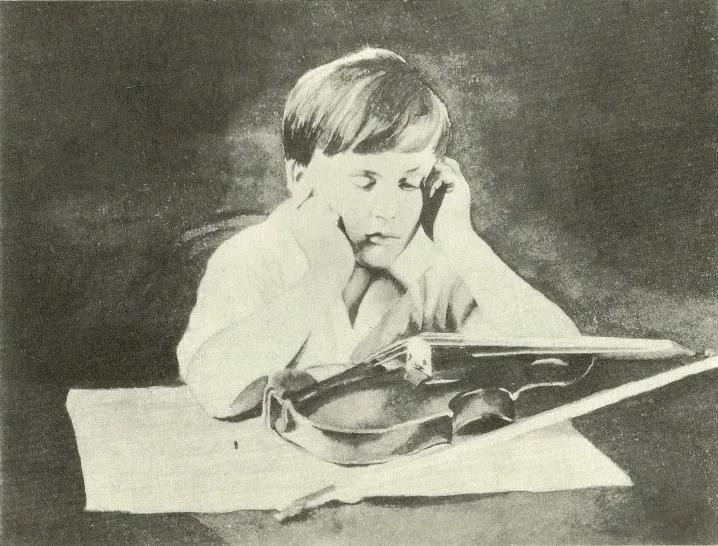
Got a story? Maybe he hates practising. Maybe he just broke it. Maybe he’s dreaming about a concert hall. Now notice something: the drawing didn’t give you any of that. It’s a boy and a violin. The rest, you brought.
That gap between what’s on the card and what you saw in it is the whole idea behind the Thematic Apperception Test. I think it’s one of the cleverest ideas psychology ever had.
What hooked me about the TAT isn’t the mystique. It’s that it solves a measurement problem most personality tests ignore: ask people what they want, and they tell you who they’d like to be.
What is the Thematic Apperception Test?
The Thematic Apperception Test (TAT) is a projective psychological test. You’re shown ambiguous pictures of people, one at a time, and asked to make up a story about each. The stories are then read for recurring themes: what the characters want, what they fear, and how things turn out for them.
Christiana Morgan and Henry Murray published it in 1935 at the Harvard Psychological Clinic. Apperception is an old word for perceiving something through what you already carry inside. That’s the bet the test makes: give people a picture nobody can be sure about, and their story will say more about them than about the picture.
Here’s a detail I love. For its first years it was known as the Morgan-Murray test. When Harvard University Press published the standard set of 31 cards in 1943, the credit read Henry A. Murray and the Staff of the Harvard Psychological Clinic. Morgan’s name was gone, and the accounts of why don’t agree.
What do the original TAT cards look like?
Most of them are black-and-white drawings and paintings of people in situations that could go several ways. Card 1 is the boy with the violin you just saw. Here are two more.
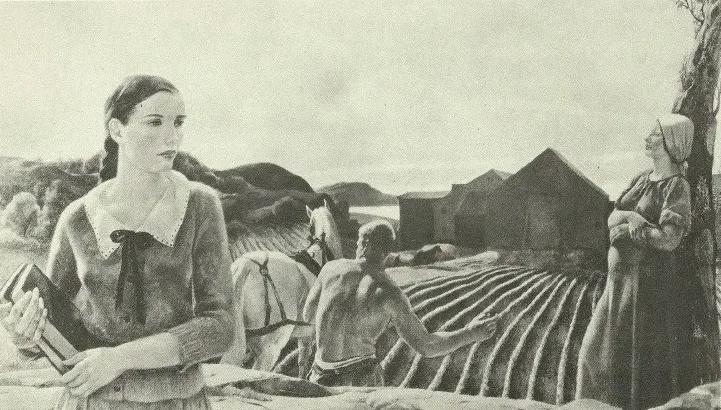
Card 2 is a country scene: a young woman holding books in the foreground, a man working the field behind her, an older woman leaning on a tree. You could read it as a family, a farewell, an escape or a rivalry. In my opinion it’s the cleverest card in the set, because it puts three people on one page and never says how they’re connected.
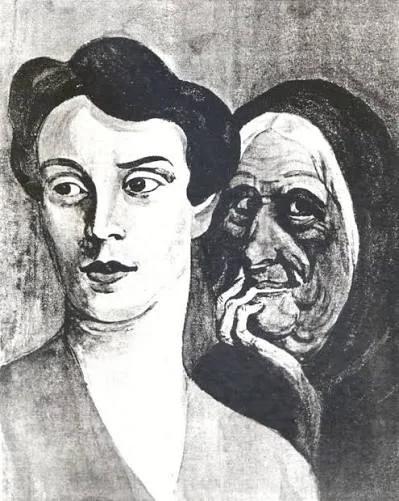
Card 12F is the one that gets under my skin. A young woman’s face, and behind her an older woman in a shawl with an expression that’s hard to read. Her mother? Her future self? Someone who wishes her harm? The card refuses to say, and that refusal is the design.
The F, by the way, stands for female. Some cards were meant for women or girls, some for men or boys, and some for everyone, and a psychologist usually shows a person only a selection.
How does the TAT work?
The instructions are simple. The cards are shown one at a time, and for each one you tell a story with a beginning, a middle and an end. The classic prompts go something like this:
the five questions, asked of every card
- 01Who are the people?
- 02What’s happening right now?
- 03What led up to it?
- 04What do they want, and what do they feel?
- 05How does it end?
Notice what’s missing: nobody asks about you. That’s the trick. Ask me what drives me and I’ll describe the person I’m trying to be. Ask me what a stranger in a picture wants and I’ll just answer, because it’s not about me. Or so I think.
One picture, three stories
The easiest way to get it is to watch it happen. Here are three quick stories about one painting (not a TAT card, but it works the same way), written for this post the way three different people might write them. They’re examples, not anyone’s real results.
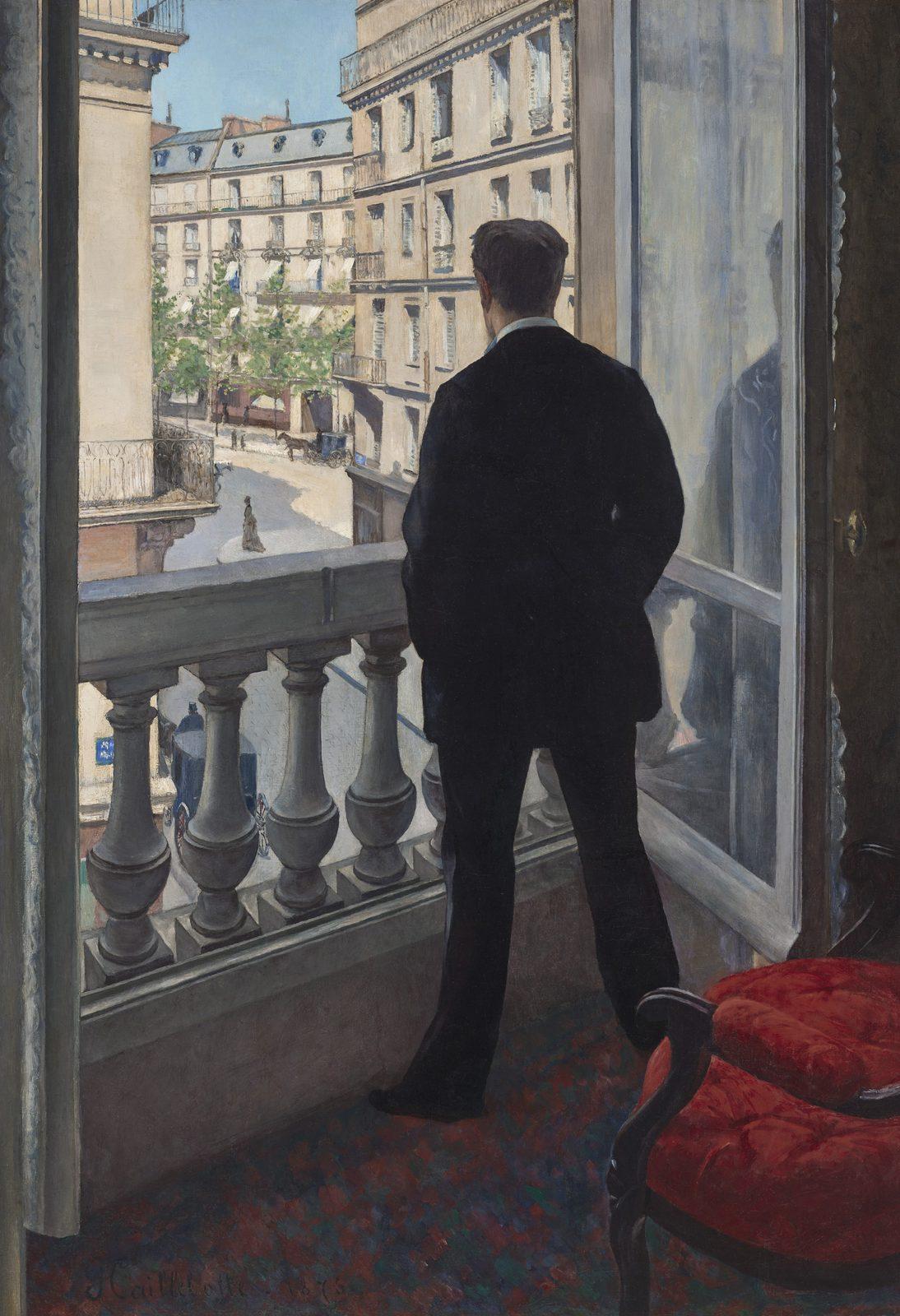
story a · written for this post
- He’s been offered the job in Lyon and has until Monday to answer.coded achievement
- He knows he could do it better than the man who had it before him.coded achievement
- By the time the street lamps come on, he’s written his reply.
story b · written for this post
- He’s waiting for his brother, who said he’d come at four.coded affiliation
- They haven’t spoken since their father’s funeral.coded affiliation
- When someone turns the corner, he’s already on the stairs.coded affiliation
story c · written for this post
- The building is his, and so is the one across the street.coded power
- Tomorrow the tenants find out the rent is going up.coded power
- He likes to stand here and picture the news reaching every window.
Same guy, same window, same afternoon. One story is about a career, one is about a brother, one is about owning the street. The little tags on the right are what a researcher would mark: ACH for achievement, AFF for affiliation, POW for power.
One story on its own means almost nothing. On a different day you might write any of the three. What researchers look for is the theme that keeps coming back across several pictures, from someone who has no idea what’s being counted.
How is the TAT scored?
Murray read each story for two things: what the hero needs, and what he called press, the stuff pushing on the hero from outside. Does the main character do something, or does something get done to him? And how do you let the story end?
Then, in the early 1950s, David McClelland and his colleagues made it measurable. They wrote scoring rules for the imagery in the stories, and three kinds of imagery are still at the heart of the research:
- Achievement: wanting to do something well, to do better than last time, or being gutted at failing.
- Affiliation: wanting closeness, friendship, belonging, or to get back together with someone.
- Power: wanting to have an effect on other people, whether that’s impressing them, steering them, or helping when nobody asked.
These days the research version is called the Picture Story Exercise, and the rulebook most researchers use is David Winter’s 1994 manual for scoring motives in running text.
What does the TAT reveal that a questionnaire can’t?
This is the finding that made me take it seriously. In 1989, McClelland, Koestner and Weinberger pulled the research together and showed that what you say motivates you and what your stories reach for barely line up. And they predict different things.
What you say predicts the choices you make when someone asks you to choose. What your stories reach for predicts what you actually drift toward on your own, over years.
Researchers call these self-attributed and implicit motives. I’d put it like this: there’s what you say you want, and there’s what pulls you when nobody’s asking. For a lot of us, those two aren’t the same.
And the mismatch seems to cost something. In one well-known study, people who made progress on goals that didn’t fit their implicit motives didn’t feel any better for it (Brunstein, Schultheiss and Grässmann, 1998).
Is the TAT reliable and valid?
Honest answer: it depends entirely on how it’s scored. I don’t want to oversell this, because the TAT has a mixed reputation and a lot of it is deserved. In clinics it was often read by gut feel. A psychologist would look at the stories and say what they suggested. Two psychologists, same stories, two different conclusions, and no way to check who was right.
A big review in 2000 by Lilienfeld, Wood and Garb was tough on projective tests used that way. But it also found that a few TAT scoring systems held up, and scoring motives was one of them. The difference is rules. If every sentence is scored against a published manual, someone else can score it again and you can compare the two.
So here’s my take. As a crystal ball for your whole personality, the TAT promises more than it can deliver. As a way to measure what your imagination keeps reaching for, scored by rules, it’s one of the oldest tools in psychology that still works.
Why is the TAT so rarely used outside labs?
Scoring by hand is brutally slow. A trained coder goes through every sentence against the manual, and a full set of stories takes hours per person. So for most of a century, the method stayed in research labs.
That changed recently. In 2025 two research groups trained language models on stories that experts had already scored, and reported that the models scored new stories about as accurately as trained people do (Nilsson et al., 2025; Brede et al., 2025). Hours became seconds.
the test in six dates
- 1935Morgan and Murray publish the Thematic Apperception Test.
- 1943Harvard publishes the standard set of 31 cards, under Murray’s name.
- 1953McClelland and colleagues publish rules for scoring motives in the stories.
- 1989Implicit and self-attributed motives shown to predict different things.
- 1994Winter’s manual for scoring motive imagery in running text.
- 2025Machine coders reported to match trained human coders.
Can you take the TAT online?
Not the original. The cards are still under copyright and are meant to be used by a trained psychologist. But you can try the same method, and that’s exactly why I built a free version on this site.
You’ll see four public-domain paintings, one at a time, and write a short story for each, 40 to 80 words. Then you describe the life you’d have if every goal you have came true. Each sentence gets read for the three motives, and you see what your stories reach for next to what you say you want.
It’s free, there’s no account, and it takes about five minutes. The paintings are different from the ones in this post, so reading this won’t skew your stories.
Two honest caveats. My version reads more broadly than Winter’s manual, which only counts the clearest cases, so your numbers can’t be compared with research scores. And four stories is a small sample. Treat the result as a place to look, not a verdict.
Questions people ask
What does the Thematic Apperception Test measure?
It explores what a person’s imagination keeps reaching for: motives like achievement, affiliation and power, and themes like how characters deal with conflict and how their stories end. In research it’s mostly used to measure implicit motives.
How many cards are in the TAT?
The standard 1943 set has 31 cards. Nobody is shown all of them: a psychologist picks a selection, partly by the person’s age and gender.
Who created the Thematic Apperception Test?
Christiana Morgan and Henry Murray published it in 1935 at the Harvard Psychological Clinic. From 1943 the standard edition carried Murray’s name.
Can the TAT diagnose anything?
Not on its own. Read by impression, it isn’t reliable enough to diagnose anything. Scored with published rules, it’s a research measure of motives. The free version on this site isn’t clinical in any way.
What’s the difference between the TAT and the Picture Story Exercise?
The Picture Story Exercise is the research version of the TAT. It uses a set of pictures with known pull on each motive, and scores the stories with published rules for motive imagery, usually Winter’s 1994 manual.
Dr. Walid Messaoudi